
Global Multi-Level KV Cache
Background
Section titled “Background”Long-context inference repeatedly reads historical KV cache during autoregressive decoding. As model sizes and context windows grow, device memory capacity and bandwidth become major constraints. A device-only cache also makes a cold request recompute a prefix even when the same prefix was produced by an earlier request or another xLLM instance.
xLLM extends the device prefix cache into a three-level hierarchy:
| Tier | Purpose | Lifetime |
|---|---|---|
| Device HBM | Lowest-latency KV used by the current forward pass | Device-local |
| Host cache | Pinned CPU-memory staging and reusable host prefix cache | xLLM process |
| Mooncake Store | Distributed KV objects shared across xLLM processes and restarts | Store cluster |
A request first checks the Host prefix cache. Missing full blocks can be fetched from Mooncake Store into preallocated Host blocks, restored to HBM layer by layer, and reused without recomputing the matched prefix. Completed HBM blocks are asynchronously copied back to Host memory and then written to Mooncake Store.
The current implementation uses HierarchyBlockManagerPool to manage block allocation, mounting, and lifetime; HierarchyKVCacheTransfer to perform unified Host-to-Device and Device-to-Host transfers; and one KVCacheStore in each worker to access Mooncake Store. A single Store client can manage the target model, a speculative draft model, and multiple BlockType values from the same model.
Architecture
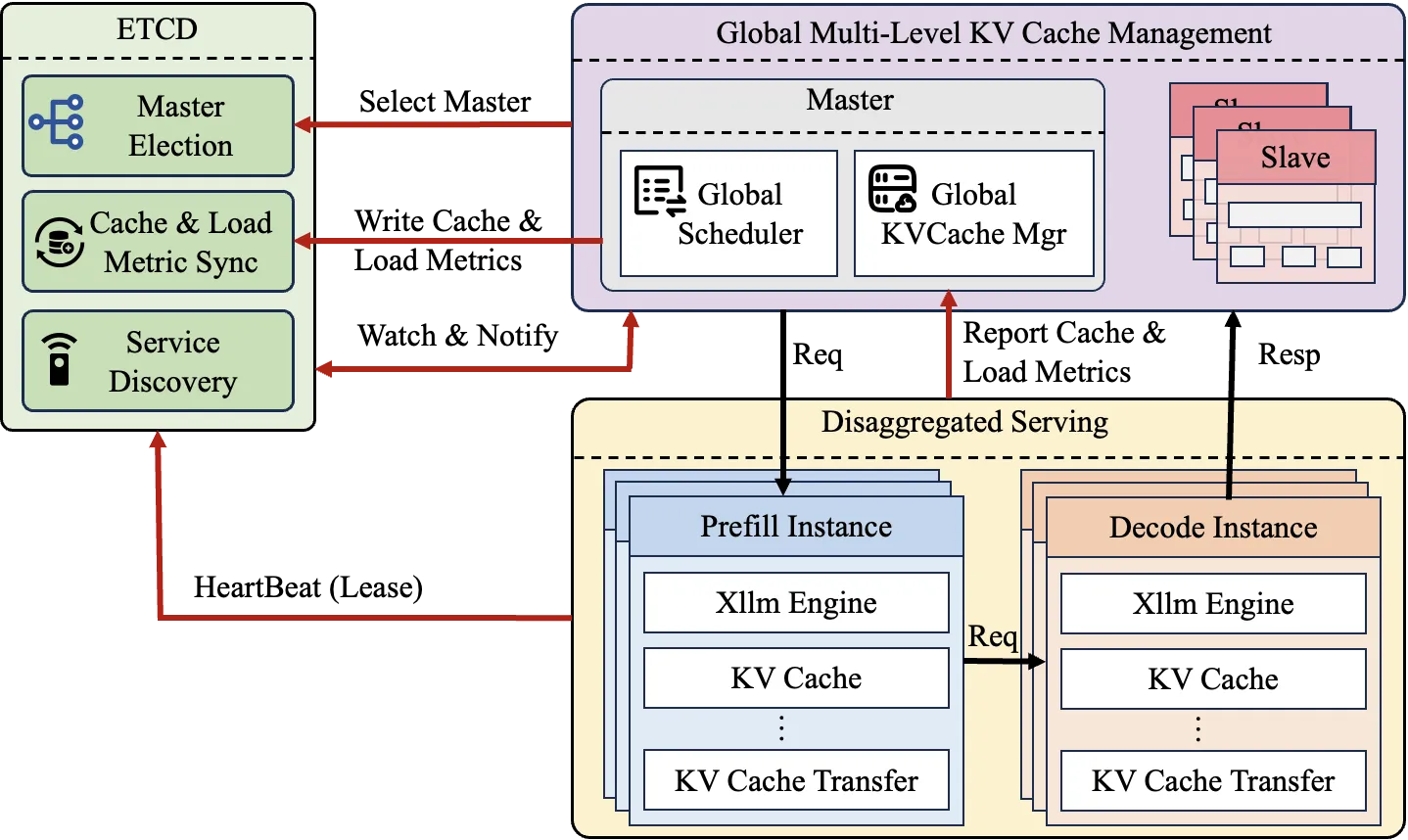
Section titled “Architecture”The deployment can contain the following components:
- etcd: Registers compute instances and synchronizes service metadata.
- xLLM Service: Routes requests and manages fused or disaggregated Prefill/Decode instances.
- HierarchyBlockManagerPool: Probes the device and Host prefix caches, creates G2H, H2D, and D2H2G plans, and publishes or releases blocks after asynchronous work completes.
- HierarchyKVCacheTransfer: Registers target and draft cache domains, creates Host caches, and performs Host-to-Device and Device-to-Host copies.
- KVCacheStore: Maps each logical block to one or more Mooncake objects and performs batched existence checks, reads, and writes.
- xLLM Worker: Owns the device and Host KV caches,
HierarchyKVCacheTransfer, andKVCacheStore, and executes inference. - Mooncake Store: Provides the distributed, process-independent KV object tier.
The service-level architecture is shown below:
Unified Cache Domains and Store Keys
Section titled “Unified Cache Domains and Store Keys”HierarchyKVCacheTransfer supports multiple registered cache domains. Normal inference registers only the target-model domain. Speculative decoding registers the target and draft models with the same transfer instance so they share one Host-transfer layout and one KVCacheStore:
| Cache domain | CacheRole | Store key_component |
|---|---|---|
| Target model | TARGET | Fixed to main |
| Embedded draft | DRAFT | spec_draft::<algorithm>::embedded |
| Separate draft model | DRAFT | spec_draft::<algorithm>::<directory-name>::<normalized-path-digest> |
During initialization, the Store builds an index by BlockType. Every cache domain that supports that BlockType produces a separate physical object. For example, when both the target and draft models contain BlockType::KV, one logical KV block maps to two Store objects. If a BlockType exists only in the target model, only the target object is generated.
The current object-key namespace is xllm-kv-v3. Conceptually, a key contains the following fields:
Non-MLA: xllm-kv-v3 + model_id + key_component + tp_size                      + block_type + tp_rank + schema_hash + block_hash
MLA: xllm-kv-v3 + model_id + key_component + mla + block_type + schema_hash + block_hashmodel_idis the target-model namespace and is included in both target and draft objects.key_componentseparates the target model, speculative algorithm, and draft-model source.- Non-MLA caches use
tp_size,tp_rank, andblock_typeto isolate different parallel topologies, ranks, and cache types. - MLA KV cache is replicated across ranks, so its object key uses a fixed
mlamarker and contains neithertp_sizenortp_rank. Every rank reads through the same object key, while only TP rank 0 writes to Mooncake Store. schema_hashis derived from each tensor’s role, dtype, and per-block shape, excluding the number of Host blocks. Changing onlyhost_blocks_factortherefore does not change object keys, while a cache-layout change automatically selects a new key space.block_hashis the 128-bit content hash of the corresponding token block.
The Store API exposes logical blocks to its caller and expands them into physical cache-domain requests internally. A worker reports a hit only when all physical objects for that logical block exist and are read successfully. PrefetchResult then applies a logical AND across all TP ranks. A Store hit is publishable only when it is complete across both cache domains and TP ranks.
Block Lifecycle
Section titled “Block Lifecycle”Fused instances and the Prefill side of disaggregated PD use the complete Mooncake admission, Host restore, and write-back path. Decode keeps Store enabled for its Host/Mooncake write-back path, while its request-admission path remains Device-prefix-only. With speculative decoding enabled, each logical block operation in the following diagram covers every target or draft cache domain that supports its BlockType.
sequenceDiagram    autonumber
    participant Client as Client / xLLM Service    participant Scheduler as Scheduler    participant BlockMgr as HierarchyBlockManagerPool    participant Engine as Engine / RemoteWorker    participant Result as PrefetchResult / Async Callback    participant Worker as TP Workers    participant Store as Mooncake Store    participant Host as Host Cache    participant HBM as Device HBM
    rect rgb(235, 245, 255)        Note over Client,Store: Phase 1: request admission and Mooncake prefetch
        Client->>Scheduler: add_request(request)        Scheduler->>BlockMgr: prefetch_from_storage(request)        BlockMgr->>Host: Probe Host Prefix Cache        Host-->>BlockMgr: Existing blocks and holes        BlockMgr->>Host: Allocate G2H destinations for holes        Host-->>BlockMgr: Host block IDs
        Note over BlockMgr,Store: If Host already covers the prefix, Store RPCs are skipped        BlockMgr->>Engine: prefetch_from_storage(G2H infos)        Engine->>Result: Create worker-by-block result matrix
        par All TP ranks            Engine->>Worker: PrefetchFromStorage(G2H batch)            Worker->>Worker: Expand each BlockType into cache-domain objects            Worker->>Store: BatchIsExist(all physical keys)            Store-->>Worker: Physical-existence bitmap            opt All physical objects for a logical block exist                Worker->>Store: BatchGet(all component keys, Host tensors)                Store-->>Worker: Fill each domain's Host tensors            end            Worker->>Worker: Aggregate a rank-local logical bitmap            Worker-->>Result: Logical bitmap and completion        end
        loop Admission polling            Scheduler->>BlockMgr: update_prefetch_result(timeout)            BlockMgr->>Result: completed()?        end        BlockMgr->>Result: merged_hits()        Result-->>BlockMgr: Logical AND across all TP ranks        Note right of Result: Every cache domain must hit within one rank<br/>then all TP ranks are ANDed
        BlockMgr->>Host: Release Store-miss destinations        BlockMgr->>Host: Cache Store-hit blocks        BlockMgr->>BlockMgr: Compute reachable prefix and mount Host state        BlockMgr-->>Scheduler: Prefetch complete        Scheduler->>Scheduler: AdmissionReady / enqueue_ready_request        Note over Scheduler,Result: Workers do not directly callback the Scheduler    end
    rect rgb(240, 255, 240)        Note over Scheduler,HBM: Phase 2: Host-to-HBM restore and forward
        Scheduler->>BlockMgr: allocate(sequence, num_tokens)        BlockMgr->>BlockMgr: Merge Device and mounted Host prefixes        BlockMgr->>HBM: Allocate missing Device blocks        HBM-->>BlockMgr: Device block IDs        BlockMgr->>Host: Best-effort allocate future D2H destinations        Host-->>BlockMgr: Reserved Host block IDs        BlockMgr->>BlockMgr: Publish Device Prefix metadata        Note over BlockMgr,HBM: Metadata publication is token-cursor bounded but precedes physical H2D completion        BlockMgr->>BlockMgr: Build layer-wise H2D plan
        Scheduler->>BlockMgr: transfer_blocks(batches)        BlockMgr->>Engine: Enqueue TransferBlocks(H2D, batch_id)        BlockMgr-->>Scheduler: Return after dispatch, without waiting for H2D completion
        par All TP ranks            Engine->>Worker: Register H2D transfer            Worker->>Worker: Create LayerSynchronizer(batch_id)            Worker->>Worker: Schedule load_from_host asynchronously            Worker-->>Engine: Registration ACK with scheduled block count            Engine->>Worker: Forward(batch_id), ordered after registration            Worker->>Worker: Attach LayerSynchronizer(batch_id)            Note right of Worker: Speculative target/draft mappings share<br/>the same batch and synchronizer
            loop Each layer-copy range                Worker->>Host: Read Host KV tensors                Host-->>Worker: Host KV                Worker->>HBM: Async H2D copy and record event                Worker->>Worker: Current compute layer waits for event                Worker->>HBM: Read KV after the event completes            end
            Worker-->>Engine: Forward output        end
        Note over Scheduler,Worker: There is no H2D-complete callback to the Scheduler    end
    rect rgb(255, 245, 235)        Note over Scheduler,Store: Phase 3: HBM-to-Host-to-Mooncake write-back
        Scheduler->>BlockMgr: deallocate(completed sequence)        BlockMgr->>BlockMgr: Publish completed Device Prefix metadata        BlockMgr->>BlockMgr: Collect HBM to reserved-Host block pairs        BlockMgr->>BlockMgr: Reset sequence while offload pairs retain block references
        Scheduler->>BlockMgr: transfer_offload_blocks()        BlockMgr->>Engine: Submit asynchronous D2H2G plans
        par All TP ranks            Engine->>Worker: TransferKvBlocks(D2H2G)            Worker->>Worker: Copy stream waits for compute stream            Worker->>HBM: Read Device KV            HBM-->>Worker: Device KV            Worker->>Host: D2H copy for each cache domain and synchronize stream            Worker->>Worker: Expand physical objects and deduplicate by key            opt Non-MLA or MLA TP rank 0                Worker->>Store: BatchIsExist(unique keys)
                alt Store key is absent                    Worker->>Store: BatchPut(missing keys, Host tensors)                    Store-->>Worker: Put results                else Store key already exists                    Worker->>Worker: Skip overwrite and count it as present                end            end
            Note right of Worker: Non-zero MLA ranks skip Store writes            Worker->>Worker: Logical put succeeds only if all physical objects succeed            Note right of Worker: Partial BatchPut failure is logged only<br/>and does not change D2H success            Worker-->>Engine: Full block count when D2H succeeds        end
        Engine-->>Result: TP futures        Result->>Result: Validate every TP result against the expected block count        Result-->>BlockMgr: Future callback(copy_ok)        BlockMgr->>HBM: Always release offload-held Device blocks
        alt D2H succeeds on every TP rank            BlockMgr->>Host: Publish Host Prefix Cache        else D2H fails on any TP rank            BlockMgr->>Host: Publish nothing and release reserved Host blocks        end
        Note over Scheduler,Result: Offload completion is handled by the BlockManager callback, not the Scheduler    end
Speculative-Decoding Cache
Section titled “Speculative-Decoding Cache”When speculative decoding and the Host cache are enabled, SpeculativeWorkerImpl makes the target and draft workers reuse one HierarchyKVCacheTransfer. Both cache domains must share the same producer stream. After registration is finalized, xLLM creates their Host caches, Host-transfer implementation, and KVCacheStore together.
The unified cache domains have the following behavior:
- G2H prefetch reads both target and draft objects. If any object is missing, the logical block is treated as a miss so xLLM never restores an incomplete draft state.
- H2D and D2H requests create separate
target_mappingsanddraft_mappings, but advance under the samebatch_idand layer synchronizer. - D2H2G write-back first copies both cache domains into their Host caches, then writes each domain through the same
KVCacheStoreinto its own key space. - Draft keys automatically include the speculative algorithm and draft source. Changing the draft path selects new keys. If weights are replaced in place at the same path, change
model_idas well.
Normal non-speculative inference still registers only the main cache domain and retains the previous single-domain behavior.
Disaggregated PD
Section titled “Disaggregated PD”In disaggregated PD, Mooncake Store admission and Host-to-HBM restore run on the Prefill instance. The Decode instance allocates destination Device blocks before Prefill starts and only probes its Device Prefix Cache during admission; it does not mount Host aliases, fetch a prefix from Mooncake, or schedule Host-to-Device restoration. Decode still enables Store and Host cache capacity for its write-back path.
sequenceDiagram    autonumber
    participant Client as Client / xLLM Service    participant PSched as PREFILL Scheduler    participant PBlock as PREFILL BlockManager    participant PWorker as PREFILL TP Workers    participant Store as Mooncake Store    participant Host as PREFILL Host Cache    participant PHBM as PREFILL HBM    participant DService as DECODE Service / Scheduler    participant DBlock as DECODE BlockManager    participant KVTransfer as PD KV Transfer (Mooncake)    participant DHBM as DECODE HBM
    rect rgb(235, 245, 255)        Note over Client,PHBM: Phase 1: PREFILL admission and Mooncake restore
        Client->>PSched: add_request(request, decode_address)        PSched->>PBlock: prefetch_from_storage(request)        PBlock->>PWorker: TP-parallel PrefetchFromStorage(G2H)        PWorker->>Store: BatchIsExist / BatchGet        Store-->>PWorker: Fill registered Host tensors        PWorker->>Host: Store-hit Host blocks are ready        PWorker-->>PBlock: Rank-local bitmap through PrefetchResult        PBlock->>PBlock: TP logical AND and mount Host state        PSched->>PBlock: Poll update_prefetch_result        PBlock-->>PSched: Prefetch complete        PSched->>PSched: enqueue_ready_request to PREFILL dispatch queue    end
    rect rgb(250, 240, 255)        Note over PSched,DHBM: Phase 2: allocate Decode destinations first
        PSched->>DService: AddNewRequests(prompt metadata)        DService->>DBlock: try_allocate(DECODE sequence)        DBlock->>DHBM: Probe Device Prefix Cache only        DBlock->>DHBM: Allocate blocks for the missing suffix        Note over Store,DBlock: DECODE admission does not fetch Host/Mooncake prefix or schedule H2D restore<br/>Store remains enabled for DECODE write-back        DBlock-->>DService: Allocation success        DService->>DService: Collect D block IDs and remote_shared_num        DService-->>PSched: Allocation response
        PSched->>PSched: Save TransferKVInfo        PSched->>PSched: Advance transfer cursor past D-side shared prefix        PSched->>PSched: Enqueue request into PREFILL request_queue    end
    rect rgb(240, 255, 240)        Note over PSched,DHBM: Phase 3: PREFILL forward and P-to-D KV transfer
        PSched->>PBlock: Allocate PREFILL sequence        PBlock->>Host: Use mounted Store/Host prefix        PBlock->>PHBM: Allocate Device blocks        PBlock->>PBlock: Build Host-to-HBM restore plan        PSched->>PBlock: transfer_blocks(batches)        PBlock->>PWorker: Register H2D plan and batch_id        PSched->>PWorker: PREFILL Forward        Note over PWorker,PHBM: Forward attaches LayerSynchronizer by batch_id<br/>and waits for the required H2D events
        alt PUSH            PWorker->>KVTransfer: push_kv_blocks_async(P local to D remote)            Note over PWorker,KVTransfer: Transfer advances layer by layer with PREFILL<br/>and skips D-side shared blocks            KVTransfer->>PHBM: Read computed PREFILL KV            KVTransfer->>DHBM: Push into preallocated Decode blocks            PWorker->>PWorker: Wait for KV push before returning Forward            PWorker-->>PSched: Forward output / first token
            PSched->>DService: FirstGeneration(token, mode=PUSH)            DService->>DService: Append first token without PULL            DService->>DService: Enqueue Decode request            DService-->>PSched: FirstGeneration success        else PULL            PWorker-->>PSched: Forward output / first token            PSched->>DService: FirstGeneration(token + P source metadata, mode=PULL)            DService->>KVTransfer: pull_kv_blocks(P source to D destination)            KVTransfer->>PHBM: Read PREFILL KV            KVTransfer->>DHBM: Write Decode blocks and recurrent state            KVTransfer-->>DService: Pull success            DService->>DService: Enqueue only after pull succeeds            DService-->>PSched: FirstGeneration success        end
        PSched->>PBlock: cache_prefill_blocks after FirstGeneration succeeds        PSched->>PBlock: Deallocate PREFILL sequence        Note over PBlock,Store: PREFILL then uses the common asynchronous D2H-to-Host-to-Mooncake write-back path    end
    rect rgb(255, 245, 235)        Note over DService,DHBM: Phase 4: DECODE execution
        DService->>DHBM: Decode Forward uses Device blocks        DService-->>Client: Token stream    end
The scheduler supports both PUSH and PULL through kv_cache_transfer_mode. The current code no longer provides a kv_cache_transfer_type option. Enable the global Mooncake Store tier on both Prefill and Decode, using disjoint store_local_hostname base-port ranges.
Deployment
Section titled “Deployment”Prerequisites
Section titled “Prerequisites”- Build and install xLLM.
- Install xLLM Service when service routing or disaggregated PD is required.
- Build or install the Mooncake Store
mooncake_masterandmooncake_clientbinaries. - Reserve enough Host memory. Mooncake Store requires
--enable_prefix_cache=trueand--host_blocks_factor > 1.
If Mooncake dependencies or the required Go toolchain are missing, install them with root privileges before building:
sudo bash -c 'cd third_party/Mooncake && bash dependencies.sh -y'Mooncake’s etcd-backed high availability backends are enabled by default when building xLLM and the bundled Mooncake binaries:
MAX_JOBS=32 SKIP_EXPORT=1 \ python setup.py build --device npucmake --build build/cmake.linux-aarch64-cpython-311 \ --target mooncake_master mooncake_client -j32Ready-to-use HA master, independent Store client, and xLLM argument scripts are available under scripts/kvcache_store/.
Start a Minimal Mooncake Store
Section titled “Start a Minimal Mooncake Store”The following TCP example uses Mooncake’s P2P handshake, so no separate Transfer Engine metadata service is required:
export MC_STORE_CLUSTER_ID=xllm-mooncake
mooncake_master \  --rpc_address=0.0.0.0 \  --rpc_port=50051
Start at least one resource-owning Store client:
mooncake_client \ --host=0.0.0.0:50053 \ --port=50052 \ --global_segment_size=4GB \ --master_server_address=127.0.0.1:50051 \ --metadata_server=P2PHANDSHAKE \ --protocol=tcpStart a High-Availability Mooncake Store Cluster
Section titled “Start a High-Availability Mooncake Store Cluster”First start an etcd cluster reachable by every Mooncake master. Then start one master instance on each master node. All instances use the same etcd endpoints and cluster_id, while rpc_address must identify the reachable address of that specific instance:
mooncake_master \ --enable_ha=true \ --ha_backend_type=etcd \ --ha_backend_connstring="10.0.0.1:2379;10.0.0.2:2379;10.0.0.3:2379" \ --cluster_id=xllm-mooncake \ --rpc_address=10.0.1.11 \ --rpc_port=50051Store clients and xLLM use etcd to discover and follow the current leader instead of binding to one master address:
export MC_STORE_CLUSTER_ID=xllm-mooncakeMOONCAKE_HA_ENTRY='etcd://10.0.0.1:2379;10.0.0.2:2379;10.0.0.3:2379'
mooncake_client \  --host=0.0.0.0:50053 \  --port=50052 \  --global_segment_size=4GB \  --master_server_address="${MOONCAKE_HA_ENTRY}" \  --metadata_server=P2PHANDSHAKE \  --protocol=tcp
/path/to/xllm \  --enable_prefix_cache=true \  --host_blocks_factor=4 \  --enable_kvcache_store=true \  --store_protocol=tcp \  --store_master_server_address="${MOONCAKE_HA_ENTRY}" \  --store_metadata_server=P2PHANDSHAKE \  --store_local_hostname=127.0.0.1:12345
The etcd:// prefix in store_master_server_address selects the HA leader-discovery backend. Do not add http:// to the endpoint list after that prefix. When using a custom cluster_id, every Mooncake master, Store client, and xLLM process must use the same MC_STORE_CLUSTER_ID.
Start etcd and xLLM Service
Section titled “Start etcd and xLLM Service”This step is required for service routing and disaggregated PD, but not for a standalone fused xLLM process:
./etcd \ --listen-peer-urls=http://0.0.0.0:10999 \ --listen-client-urls=http://0.0.0.0:10998./xllm_master_serving \ --etcd_addr=127.0.0.1:10998 \ --http_server_port=28888 \ --rpc_server_port=28889 \ --tokenizer_path=/path/to/tokenizer_config_dir/Fused xLLM Example
Section titled “Fused xLLM Example”/path/to/xllm \ --model=/path/to/model \ --model_id=my-model-revision-v1 \ --enable_prefix_cache=true \ --host_blocks_factor=4 \ --enable_kvcache_store=true \ --store_protocol=tcp \ --store_master_server_address=127.0.0.1:50051 \ --store_metadata_server=P2PHANDSHAKE \ --store_local_hostname=127.0.0.1:12345 \ --prefetch_batch_size=8 \ --prefetch_timeout=30000store_local_hostname is a base Transfer Engine endpoint. Each worker uses base_port + worker_rank, so the entire port range must be free and reachable.
For RDMA, set --store_protocol=rdma. Use --store_rdma_devices=mlx5_0,mlx5_1 to select HCAs for the Store client embedded in each xLLM Worker, or leave it empty for Mooncake auto-discovery. Initialization failures remain RDMA failures and never fall back to TCP. xLLM does not read DEVICE_NAMES; the standalone mooncake_client uses its own --device_names option.
Speculative decoding does not require a separate draft Store namespace. xLLM automatically generates a distinct key_component for the draft cache. If --model_id is omitted, xLLM uses the final component of the model path; production deployments should still provide a stable --model_id that identifies the model version.
Disaggregated PD Example
Section titled “Disaggregated PD Example”Use the normal Disaggregated PD flags and enable Store on both roles. Use different store_local_hostname base ports for Prefill and Decode:
/path/to/xllm \ --enable_disagg_pd=true \ --instance_role=PREFILL \ --kv_cache_transfer_mode=PUSH \ --enable_prefix_cache=true \ --host_blocks_factor=4 \ --enable_kvcache_store=true \ --store_protocol=tcp \ --store_master_server_address=127.0.0.1:50051 \ --store_metadata_server=P2PHANDSHAKE \ --store_local_hostname=127.0.0.1:12345Enable Store on Decode with a different local endpoint range:
/path/to/xllm \ --enable_disagg_pd=true \ --instance_role=DECODE \ --kv_cache_transfer_mode=PUSH \ --enable_prefix_cache=true \ --host_blocks_factor=4 \ --enable_kvcache_store=true \ --store_protocol=tcp \ --store_master_server_address=127.0.0.1:50051 \ --store_metadata_server=P2PHANDSHAKE \ --store_local_hostname=127.0.0.1:13345See the CLI Reference for all KVCacheStoreConfig parameters.
Correctness and Operational Notes
Section titled “Correctness and Operational Notes”- Store hits use two levels of completeness checks: each worker must successfully read every registered cache domain for the
BlockType, and every TP rank must then report a hit before the block is mounted into the Host Prefix Cache. prefetch_timeoutstops issuing new prefetch batches after the timeout, but admission still waits for every in-flight TP batch to finish.0waits indefinitely.- H2D registration does not wait for the physical copy. Forward attaches a
LayerSynchronizerusingbatch_idand waits at the corresponding layers. The Scheduler receives no H2D-complete callback. - Host Prefix publication depends only on successful D2H completion from every TP rank. Mooncake
BatchPutis best-effort; a partial Store write failure is logged but does not invalidate an already successful Host copy. BatchPutfirst deduplicates object keys and callsBatchIsExist. Existing objects are never overwritten, and duplicate objects in one batch are written only once. A logical block counts as a Store success only when every cache-domain object already exists or is written successfully.- The current Store key version is
xllm-kv-v3. Host-block capacity is excluded fromschema_hash, while tensor role, dtype, per-block shape, TP topology,BlockType, and cache-domain identity isolate the key space. - Weight contents are not automatically encoded in object keys. Use a new
model_idwhenever target or draft weights, quantization, or any other setting that can change KV values is updated, and rotate or clean the old Store namespace as needed. - In PD, Prefill and Decode both enable Store. They must use disjoint
store_local_hostnamebase-port ranges because both roles reuse worker ranks and each worker bindsbase_port + worker_rank.